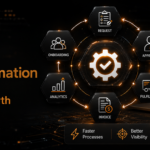
Managing finance, HR, and daily operations through separate systems can create major challenges for growing businesses. Disconnected tools often lead to data silos, manual workflows, delayed reporting, and communication gaps between departments. As organizations scale, these inefficiencies can slow productivity and impact decision-making.This is where an application for ERP becomes essential. Enterprise Resource Planning (ERP) applications help businesses centralize their core processes into a single integrated platform. From automating financial management to streamlining HR tasks and improving operational visibility, ERP systems simplify complex business workflows and improve overall efficiency.Modern ERP applications also support real-time data access, workflow automation, and better collaboration across teams. By integrating multiple business functions into one system, organizations can reduce operational bottlenecks, improve accuracy, and make faster, data-driven decisions.
What Is an ERP?
An application for ERP, or Enterprise Resource Planning, is a centralized software solution designed to manage and automate core business processes within a single platform. Instead of using separate systems for finance, human resources, inventory, procurement, and operations, businesses can integrate all these functions through one unified ERP application.
ERP systems help organizations improve efficiency by connecting departments and enabling real-time data sharing across the business. This centralized approach reduces duplication, minimizes manual work, and improves collaboration between teams. Employees can access accurate information quickly, helping businesses make faster and more informed decisions.
Unlike traditional management software that operates independently, modern ERP applications provide end-to-end visibility into business operations. Many cloud-based ERP solutions also offer scalability, remote accessibility, and workflow automation, making them ideal for businesses looking to streamline processes and support long-term growth.
Why Businesses Need ERP Applications
As businesses grow, managing multiple departments through disconnected systems becomes increasingly difficult. Finance teams may rely on separate accounting tools, HR departments may use standalone employee management software, and operations teams often work with different inventory or workflow systems. This lack of integration creates inefficiencies that affect productivity and decision-making.
One of the biggest challenges businesses face without ERP applications is data silos. When information is stored across multiple platforms, employees struggle to access accurate and updated data. Manual processes, repetitive data entry, and delayed communication between departments can also slow down business operations and increase the risk of errors.
An application for ERP solves these challenges by bringing all core business functions into a centralized platform. ERP systems automate workflows, improve data accuracy, and provide real-time visibility across departments. This allows teams to collaborate more effectively, reduce operational bottlenecks, and respond quickly to changing business needs. With better access to unified data and automated processes, businesses can improve efficiency, reduce costs, and support long-term scalability.
How ERP Applications Streamline Financial Management
Financial management is one of the most critical areas of any business, and manual processes can often lead to delays, inaccuracies, and compliance issues. An application for ERP helps streamline financial operations by automating accounting tasks, centralizing financial data, and improving reporting accuracy.
ERP applications simplify processes such as invoicing, payment tracking, expense management, and bookkeeping. Instead of relying on spreadsheets or multiple accounting tools, businesses can manage all financial activities within a single system. Automation reduces manual data entry, minimizes errors, and speeds up routine financial workflows.
Cloud ERP vs Traditional ERP Systems
| Feature |
Cloud ERP Systems |
Traditional ERP Systems |
| Deployment |
Hosted online through cloud providers |
Installed on company-owned servers |
| Accessibility |
Accessible from anywhere with internet access |
Limited to on-site or internal network access |
| Initial Cost |
Lower upfront investment |
Higher infrastructure and setup costs |
| Maintenance |
Managed by the service provider |
Requires dedicated in-house IT management |
Conclusion
An application for ERP has become an essential solution for businesses looking to streamline finance, HR, and operational workflows through a centralized system. By integrating multiple business functions into one platform, ERP applications help organizations reduce manual processes, improve data accuracy, and enhance collaboration across departments.
From automating financial management and HR tasks to improving inventory control and workflow efficiency, ERP systems support faster decision-making and better operational visibility. Cloud-based and AI-powered ERP solutions are also helping businesses become more scalable, flexible, and prepared for future growth.
FAQs
What industries commonly use ERP applications?
ERP applications are widely used across industries such as manufacturing, retail, healthcare, logistics, education, construction, and professional services to manage business operations more efficiently.
Can small businesses use ERP applications?
Yes, many modern ERP solutions are designed specifically for small and mid-sized businesses. Cloud ERP platforms offer affordable and scalable options for growing companies.
Why are cloud ERP solutions becoming more popular?
Cloud ERP systems offer lower infrastructure costs, faster deployment, easier scalability, remote accessibility, and automatic updates, making them a preferred choice for modern businesses.