Table of Contents
- B2B Customer Portals: Introduction
- What Is a B2B Customer Portal?
- Why B2B Customer Portals Matter for Manufacturers, Distributors and Wholesalers
- Manual Processes vs ERP-Integrated Self-Service
- Core Features of a Self-Service B2B Customer Portal
- Customer Ordering Portal
- Order Tracking and Delivery Visibility
- Invoice Access and Online Payments
- Returns, RMAs, and Credit Visibility
- Account and Document Management
- User Roles and Permissions
- ERP Integration: The Foundation of an Effective Customer Portal
- Who Benefits Most from a B2B Customer Portal?
- Key Benefits of Customer Portal Software for B2B Businesses
- Common Use Cases for B2B Customer Portals
- Customer Portal vs B2B Ecommerce: What’s the Difference?
- What to Look for in B2B Customer Portal Software
- How B2B Customer Portals Support Digital Transformation
- Final Thoughts
- Frequently Asked Questions
B2B Customer Portals: Introduction
B2B customer expectations have changed. Buyers now expect faster communication, transparency, and self-service capabilities similar to B2C experiences. To meet these demands, businesses are adopting B2B customer portal software that enables real-time access to orders, invoices, pricing, and account data.
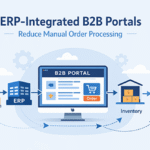
When integrated with ERP systems, B2B portal software helps businesses streamline operations, reduce manual work, and improve customer experience through a centralized digital platform.
For ERP-led manufacturers, distributors, and wholesalers, customer portals are most effective when treated as an extension of ERP systems rather than standalone tools. A modern B2B customer portal combined with a B2B client portal enables secure access to real-time data, improves collaboration, and enhances customer engagement.
A B2B customer portal sits at the centre of this shift. More than just an online account area, it acts as a secure, self-service gateway that gives customers real-time access to orders, invoices, pricing, and account information, directly connected to core business systems.
For mid-market manufacturers, distributors and wholesalers running ERP systems such as SAP Business One, Microsoft Dynamics, Oracle NetSuite, Sage or Acumatica, this shift creates a challenge. Manual order entry, invoice requests, and pricing queries increase operational overhead while slowing cash collection and extending Days Sales Outstanding (DSO).
For a broader overview of B2B portals (beyond customer portals), see: B2B Portals: What They Are, How They Work, Features, Integration & Best Practices.
Editorial note: This guide is written for mid-market manufacturers, distributors and wholesalers using ERP systems such as SAP Business One, Microsoft Dynamics, Sage, Oracle NetSuite and Acumatica, where customer portals must reflect real-time pricing, stock, orders, and invoices accurately.
What Is a B2B Customer Portal?
A B2B customer portal is a secure, ERP-integrated self-service platform that allows business customers to place orders, view real-time pricing and inventory, track deliveries, access invoices and statements, and manage account information online. Unlike B2B ecommerce sites, customer portals support account-specific pricing, role-based access, and ongoing trading relationships, making them ideal for manufacturers, distributors and wholesalers with repeat orders and complex ERP-driven processes.
In practice, a customer portal is designed for existing account relationships, where each customer sees their own pricing, products, documents, and users based on ERP rules and permissions. This makes it different from a generic ecommerce site, which typically shows the same catalogue and pricing to everyone.
A typical self-service B2B customer portal enables customers to:
- Place and repeat orders using contract pricing
- View real-time order status and delivery information
- Download invoices and statements
- Make payments or manage credit terms
- Access documents, contracts, and account details
Most importantly, an effective customer portal is ERP-integrated, ensuring customers always see accurate, real-time data rather than manually maintained or outdated information. This makes customer portals one of the most scalable ways to modernise B2B customer interactions.
Why B2B Customer Portals Matter for Manufacturers, Distributors and Wholesalers
Many B2B organisations still rely on email orders, phone calls, PDF invoices, and spreadsheet-based updates. These manual processes slow response times and place unnecessary pressure on customer service and finance teams.
Each manual order, invoice request, or delivery query carries a real internal cost. Customer service teams become order processors, finance teams chase invoice copies, and pricing errors emerge when spreadsheets replace ERP master data. Over time, this increases service workload and delays payment, directly impacting margins and working capital.
A B2B customer portal addresses these challenges by shifting routine interactions into a structured, self-service model.
For manufacturers, distributors and wholesalers, this typically results in:
- Fewer inbound calls and emails
- Faster and more accurate order processing
- Improved customer satisfaction and retention
- Lower ongoing operational effort
Customer portals are no longer optional. They are becoming essential infrastructure for businesses that want to scale efficiently while maintaining strong customer relationships.
Manual Processes vs ERP-Integrated Self-Service
For manufacturers, distributors and wholesalers, the biggest gains come from moving high-volume, repetitive workflows out of email and phone queues and into ERP-connected self-service. The comparison below shows where portals typically reduce friction and cost-to-serve.
| Workflow | Manual (Email / Phone / Spreadsheets) | ERP-Integrated Customer Portal | KPI Impact |
|---|---|---|---|
| Repeat ordering | Orders rekeyed by staff, increasing delays and error rates | Customers place repeat orders using ERP pricing rules and order history | Cost-to-serve ↓ Order accuracy ↑ |
| Pricing & availability | Spreadsheets and manual checks create inconsistencies and disputes | Account-specific pricing and real-time availability pulled from ERP | Revenue leakage ↓ Disputes ↓ |
| Order status & tracking | High volume of “where is my order?” service queries | Self-service access to live order, shipment, and backorder status | Service tickets ↓ SLA adherence ↑ |
| Invoices & statements | Finance responds to invoice copy requests, delaying payment | 24/7 self-service access to invoices, statements, and balances | DSO ↓ Finance admin ↓ |
| Payments | Manual follow-up and reconciliation effort | Online payments with clear allocation against open invoices | Time-to-payment ↓ Cash flow ↑ |
| Returns (RMAs) & credits | Email-based return handling with limited visibility | Customers initiate RMAs, track status, and view approved credits | Resolution time ↓ Satisfaction ↑ |
Core Features of a Self-Service B2B Customer Portal
Effective customer portals are built around operational workflows and measurable outcomes, not generic website functionality. Each feature should remove friction for customers while improving KPIs such as order accuracy, service workload, and Days Sales Outstanding (DSO).
For a deeper breakdown of high-impact portal capabilities, see: 6 Key B2B Web Portal Features to Drive Success.
Customer Ordering Portal
A self-service customer ordering portal moves repeat and contract orders out of email and phone queues and into a structured, ERP-driven workflow. By allowing customers to order using account-specific pricing, minimum order rules, and approved products, organisations reduce manual order entry, eliminate pricing errors, and scale order volume without increasing headcount.
- Contract and customer-specific pricing to reduce revenue leakage
- Quick reordering from order history to increase repeat order frequency
- Minimum order quantities and product rules to improve order accuracy
- Real-time product availability to reduce backorders and cancellations
By enabling customers to order independently using ERP-accurate data, organisations improve processing speed and accuracy while reducing internal handling effort.
Order Tracking and Delivery Visibility
Real-time order and delivery visibility shifts one of the highest-volume customer service queries, “where is my order?”, to self-service. When customers can see live order status, shipments, backorders, and part-shipments directly from the ERP, inbound service tickets fall and SLA performance improves without additional support staff.
- Live order status updates to reduce order-tracking enquiries
- Shipment and delivery tracking to improve transparency
- Visibility of backorders and part-shipments to reduce disputes
This functionality lowers service demand while improving customer confidence and predictability.
Invoice Access and Online Payments
Invoice and credit note self-service removes one of the most common friction points in B2B collections. When customers can access invoices, statements, and balances on demand and pay online, finance teams spend less time responding to retrieval requests, disputes decrease, and customers pay faster, reducing Days Sales Outstanding (DSO).
- Invoice and credit note downloads to reduce finance admin time
- Statements and outstanding balances to improve credit control efficiency
- Online payments and payment history to shorten time-to-payment
Improving billing visibility and payment access helps bring cash forward while lowering the operational cost of collections.
Returns, RMAs, and Credit Visibility
For manufacturers, distributors and wholesalers, returns and credits are often as operationally complex as orders. A self-service customer portal allows customers to initiate returns, track RMA status, and view associated credits without relying on email or phone-based processes.
- RMA initiation and status tracking to reduce inbound service requests
- Visibility of approved returns and credits to reduce disputes
- Integration with ERP returns workflows to maintain data integrity
By moving returns and credit visibility into the portal, organisations reduce service workload, speed up resolution cycles, and improve customer confidence in post-order processes
Account and Document Management
A B2B customer portal acts as a single source of truth for account-specific documentation. Centralising contracts, pricing documents, compliance files, and order confirmations reduces fragmented storage and manual distribution while ensuring customers always reference approved information.
- Contracts and agreements to reduce document retrieval effort
- Pricing documents to minimise disputes and outdated references
- Compliance and certification files to improve audit readiness
- Order confirmations to reduce customer follow-ups
Centralised documentation improves consistency and reduces administrative overhead across multi-site and high-volume environments.
User Roles and Permissions
B2B customer relationships often involve multiple stakeholders per account. Role-based access ensures purchasing, finance, and operations users only see data relevant to their responsibilities, improving security while reducing the risk of inappropriate access to pricing or credit information.
This supports governance and compliance while enabling customers to self-serve safely at scale.
ERP Integration: The Foundation of an Effective Customer Portal
Without ERP integration, a customer portal is limited in functionality. A fully integrated B2B customer portal software solution ensures real-time synchronization of pricing, inventory, and orders. When combined with approval workflow software, businesses can automate internal approvals and improve process efficiency.
In mid-market ERP environments, invoice retrieval and order status queries often account for a disproportionate share of service desk volume.
ERP-first integration ensures the portal reflects the system of record rather than creating a parallel data layer. Pricing, credit limits, stock availability, and order status are pulled directly from the ERP, reducing discrepancies and eliminating manual reconciliation.
- Accurate, real-time pricing and stock levels
- Live order and invoice data
- Automated data synchronisation
- Elimination of duplicate data entry
Next step: use our web portal integration guide to choose the right real-time vs scheduled pattern for your ERP and data flows.
For organisations running systems such as SAP Business One, Microsoft Dynamics, NetSuite, Acumatica, or Sage, ERP integration is essential for control and data integrity.
Who Benefits Most from a B2B Customer Portal?
B2B customer portals deliver the greatest impact for organisations with established trading relationships, structured ERP data, and high volumes of repeat interactions.
Best Fit Organisations
- Mid-market manufacturers, distributors and wholesalers with annual revenues between £5M and £100M
- ERP-led businesses running SAP Business One, Microsoft Dynamics NAV/365, Sage, NetSuite or Acumatica
- High volumes of repeat orders with customer-specific pricing and rules
- Customer service and finance teams under pressure from order and invoice queries
- CFO and operations-led initiatives focused on working capital and efficiency
Less Suitable Scenarios
- Micro-businesses or early-stage companies without sufficient process complexity
- Consumer ecommerce or catalogue-only models without account-based data
- Businesses without structured ERP data for pricing, stock, and invoices
For organisations that meet the best-fit criteria, a customer portal becomes a strategic platform that reduces friction, improves financial performance, and enables scalable growth.
If you want examples across industries and portal models, see: web portal types and real-world use cases.
Key Benefits of Customer Portal Software for B2B Businesses
When implemented with ERP integration, customer portal software delivers measurable operational and financial benefits. The most common outcomes include:
- Lower service overhead through self-service and automation
- Improved customer experience with instant access to information
- Faster order processing and fewer errors
- Faster cash collection through invoice self-service and payments
- Scalable growth without adding headcount
For more detail on outcomes and ROI drivers, see: advantages of B2B portals.
Need something to share internally?
Download the B2B Portal Datasheet for a concise overview of architecture, ERP integration patterns, and deployment options.
Common Use Cases for B2B Customer Portals
B2B customer portals are most effective when they remove repetitive, high-volume interactions from email and phone workflows. The most common use cases include:
- Repeat ordering for trade and wholesale customers
- Self-service invoice and statement access
- Order tracking for logistics-heavy operations
- Customer-specific catalogues and pricing
Customer Portal vs B2B Ecommerce: What’s the Difference?
Customer portals focus on existing customer relationships, ERP-driven self-service, and account-based data. B2B ecommerce platforms are typically designed for new customer acquisition and catalogue-led purchasing.
Many B2B organisations use ecommerce for acquisition and customer portals for ongoing service and account management.
What to Look for in B2B Customer Portal Software
Look for software that can handle account-specific pricing, real-time ERP data, and role-based access without heavy manual workarounds. The key criteria include:
- Depth of ERP and CRM integration
- Security, permissions, and access control
- Customisation and scalability
- Experience in B2B industries
- Support for complex pricing and workflows
To go deeper on evaluation and shortlisting, see: How to Choose the Right Web Portal Software.
How B2B Customer Portals Support Digital Transformation
Customer portals are often the first step in a wider digital transformation strategy. By digitising customer interactions, businesses create a foundation for automation, data-driven decision-making, and scalable operations.
Because the portal is ERP-integrated, improvements in ordering, service, and collections can be measured quickly without replatforming core systems.
Many organisations start with ordering and invoice self-service, then expand into workflows such as returns (RMAs), credit visibility, and customer-specific approvals.
Final Thoughts
A B2B customer portal is no longer just a customer convenience; it is a strategic asset. By combining self-service functionality with deep ERP integration, customer portals help manufacturers, distributors and wholesalers reduce operational friction, bring cash forward, and scale without adding complexity.
For ERP-led organisations, the fastest way to evaluate a customer portal is to identify where manual processes still exist, such as order entry, invoice access, pricing visibility, or delivery tracking. A short discovery conversation can quickly highlight where self-service will deliver the greatest impact.
Ready to explore a B2B customer portal?
Arrange a short discovery call to validate ERP objects, define a practical MVP, and identify where self-service will reduce cost-to-serve fastest.
Frequently Asked Questions
Do B2B customer portals replace ERP systems?
No. A B2B customer portal extends the ERP to customers by exposing selected, real-time data and workflows. The ERP remains the system of record for pricing, inventory, orders, and invoices.
What features should a B2B customer portal include?
At minimum: account-specific pricing and ordering, real-time order tracking, invoice and statement access, online payments, and role-based permissions, all integrated with the ERP system of record.
How long does it take to implement a B2B customer portal?
Implementation timelines vary depending on ERP complexity, data quality, and scope. ERP-first portals typically prioritise high-impact use cases such as ordering and invoice access before expanding functionality.
How does a B2B customer portal integrate with ERP systems?
A B2B customer portal integrates directly with the ERP system of record using APIs or certified connectors. This allows pricing, inventory, orders, invoices, credit limits, and returns to be synchronised in real time or near real time, ensuring customers always see accurate data without creating duplicate systems or manual reconciliation.